Thoughtographic Experiments: Tiling Results

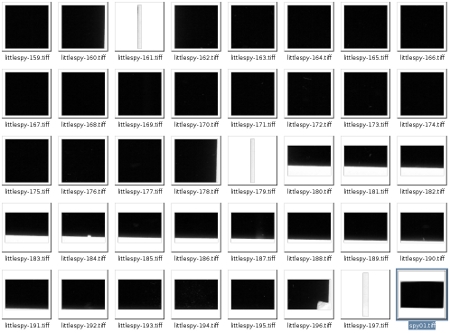
To investigate an image pixel by pixel, mm by mm or cm by cm … the already mentionned image magick trick may help. These are screenshots of my gthumb imageviewer containing 197 .tiff (f)tiles of one thoughtographic image I made earlier on
Results of further investigations into the darkness of this paper negative – original size 8 x5 cm – are hopefully soon to be published.

screenshot-1.jpg

screenshot-2.jpg

screenshot-3.jpg

screenshot-4.jpg

screenshot-5.jpg

Thoughtgraphic Experiments: SpyMirror-InstantImage-Pinhole-ChineseBox-Kamera

chinese01neg.jpg

chinesepos.jpg

Another experiment using light.

This time I customised a little case that formerly gave home to a chinese handmirror. I enlarged the focal length about 12 cm, covered the pinhole on the front with another sample spy mirror and attached an instant filmholder on the back. (Images of the camera will follow soon).

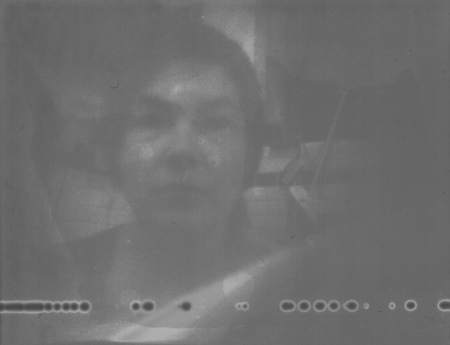
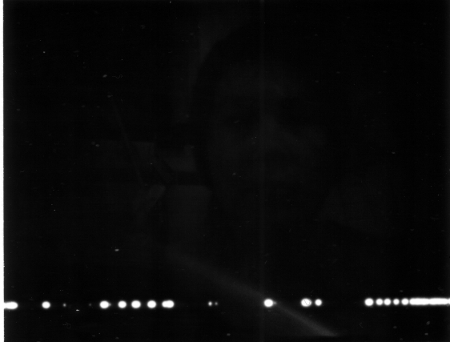
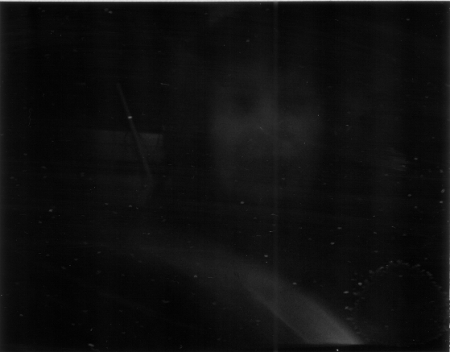
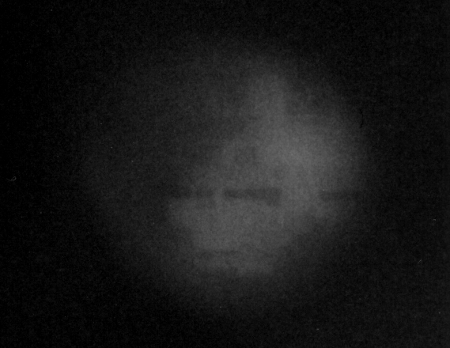
The Fuji FP 3000B is a kind of traditional instant film that uses the so called separation process. The result is always a negative and a positive. Strangely enough in this case, I got, as you may see in the results above, two positives of the same image. The only difference is, that the alleged negative is brighter and rather greyish but also: Only the little spotty line at the bottom indicates its negativeness. No other blacks or whites in the image got inverted. And then: Who are these dots anyway?

The second sitting, as you can see below shows the normal positive-negative behaviour:

chines2neg.jpg

chines2pos.jpg

Thoughtographic Experiments: Spymirror-InstantImage-Pinhole-VHSBox-Kamera

pinholespymirrorvhsboxzoom.jpg

pinholespymirrorvhsbox.jpg

As I already mentionned in an earlier post, i have now started to use light in my thoughtographic experiments as a carrier for thoughtographic exposure. The invisible fluid might expose itself through the very light, that i have been striclty excluding and banning in former thoughts and experiments, concerned that the light might be too powerful to overexpose the fragile fluidum. But now, this is exactly the new starting point of another hypothesis: The Fluidum uses light as a carrier to reveal itself in the very exposure.

Microscopically zooming into the image may expose the oh so invisible creature of thought.

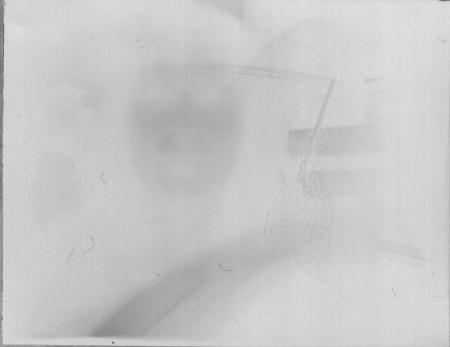
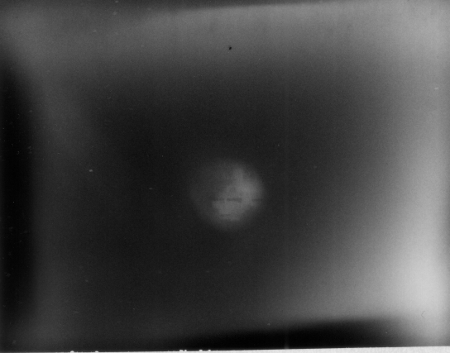
This is the result – a close up (unfortunately not yet microscopically) and beyond also the entire image – of a selfportrait (sitting time about 10 minutes, Fuji FP 3000 instant film) with a Spymirror-InstantImage-Pinhole-VHSBox-Kamera.
A VHS Box is used as a camera obscura and carrier of the instant image filmholder. The Pinhole, piercing the VHS Box, is covered by a small spy mirror (10 x 6 cm) that i kindly got as a free sample from Glaserei Kater, Hannover. The focal lenght of course is very short, just like the thickness of the VHS Box. 1 or 2 cm.

While the sitter watches him or herself in the mirror, the mirror absorbes the image and burns it onto the photographic paper. Spy mirrors are half transparent glas mirrors; from a darkroom (in this case the camera obscura) the spy (camera obscura) can see through the mirror like through a window, whereas the other side (the sitter) cannot see anything but the own reflection.